
Selected Example: Opus 13/ii
Updated: Apr 27
I chose the Piano Sonata no. 8 in C Minor, op. 13 (Pathétique) as an example partly because most collected editions include it, and its second movement in particular is a familiar staple for piano instruction.
Beethoven’s autograph manuscript is lost and no sketches for the second movement survive. The earliest source is the first edition published in Vienna by Hoffmeister in 1799:
The first edition includes a few phrase and dynamic markings, with the tempo marked only “adagio cantabile.” It completely lacks fingerings and pedaling markings:

My objective was to explore how different editors of the collected editions approached suggestions on interpretation, execution, and expression.
Tempo markings, fingerings, and marks of expression
Many of the earliest collected editions followed the metronome marking of ♪ = 60 and fingerings added by Czerny, as in BGPS 8 (Meyer/Czerny):

Curiously, a separate issue of op. 13 issued by Simrock (BGPS 47) and attributed to Czerny places the metronome marking as ♩ =60, likely an engraving error. This issue also includes numerous fingering changes and dynamic markings:

Another variant in some of the editions attributed to Czerny is the designation “cantando” and “con molto espressivo” at m. 9 (see BGPS 8 above). Notably, the edition attributed to Payer & Liszt (BGPS 11) published by Schlesinger also adds those expression markings:

Other early editions that followed that example include BGPS 24 (Launer/Hallé), BGPS 33 (Schuberth/Klauser), BGPS 39 (Brandus), BGPS 45 (Weinholtz), and many others.
Addition of fingerings also appeared early in the publication history of this sonata. Many differed only slightly from Czerny’s fingerings (see for example, BGPS 12, BGPS 25, BGPS 63, and BGPS 81). The edition published by Lee & Walker (BGPS 73) converts Czerny’s markings to English fingerings (note that ♩= 60 is also preserved here):

Most later editions agree that the metronome marking of ♩ = 60 is too fast a tempo, but several editors used the quarter note rather than the eighth note as the pulse. These include BGPS 110 (Cesi) with ♩ = 46, BGPS 130 (Winterberger) with ♩ = 40, and BGPS 136 (Bartók) which suggests a range of ♩ = 48–50.


Czerny’s edition for Cocks (BGPS 14) alters the metronome marking to ♪ = 54:

Several later editions followed that altered marking, including BGPS 17 (Bote & Bock), BGPS 20 (Böhme), BGPS 30 (Hagemann & Topp), BGPS 55 (Bachmann), and BGPS 76 (Augener/Pauer). The edition by Foote (BGPS 147) alters it only slightly to ♪ = 56.
The edition by BGPS 43 (Heugel/Marmontel) adopts ♪ = 54 and adds expression markings, dynamics, fingerings, and a rolled chord at end:


A slightly faster tempo was suggested in BGPS 36 (Bennett/Leader & Cock) at ♪ = 69. This edition eliminates phrase markings and adds English fingerings:

Macfarren’s revision of the Bennett edition (BGPS 106) retains the metronome markings but also reinstates phrase markings:

Hallé’s edition for his Practical Pianoforte School (BGPS 88) offers a range of metronome markings at the opening (♪ = 58–66), uses English fingerings, and adds numerous dynamic markings (in parentheses) but no pedaling:

Steingräber (BGPS 89) follows BGPS 88 very closely. The editions by Diemer (BGPS 143) and Taub (BGPS 231) also uses ♪ = 66.
A few faster tempos should be considered. The editions BGPS 142 (Esposito) and BGPS 145 and BGPS 164 (Moszkowski) suggest ♪ = 72:

Casella (BGPS 151) suggests an even faster tempo at ♪ = 76:

A few examples from instructive editions
Several of the examples shown above implement dynamic and phrase markings as well as fingerings and some pedaling (more on that below). Those whose main purpose was for teaching also added section headings, realization of ornaments, and/or other interpretive details.
BGPS 107 (Germer) inserted numerous changes in dynamics, phrasings, and articulation realization of ornaments, section letters, as well as fingerings:
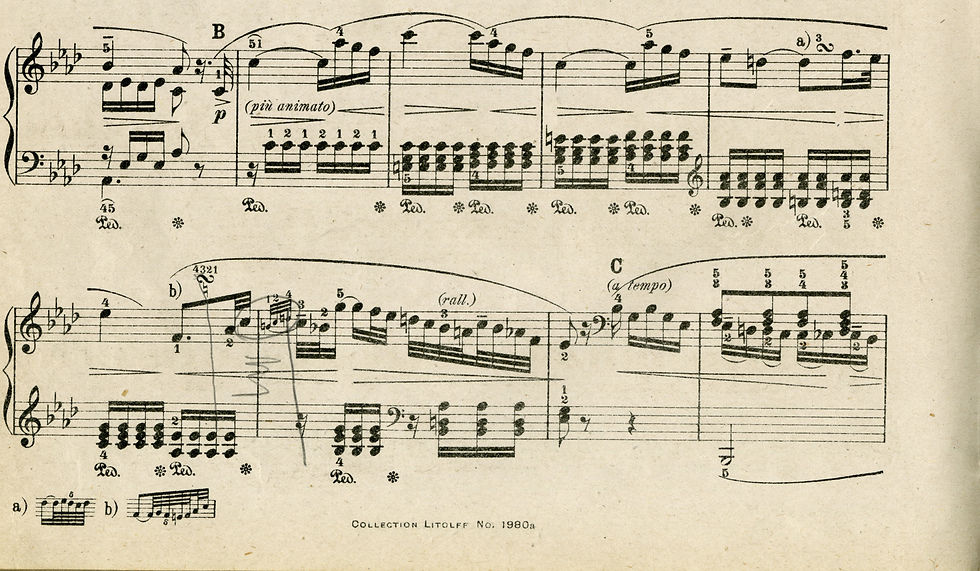
BGPS 112 (Kipper) was one of several editions that alters the metronome marking for a slightly faster tempo at m. 17 and adds dynamic, phrase breaks, articulation changes, dynamics, realizations of ornaments, as well as fingerings that vary slightly from those suggested by Czerny:

As discussed in the book, the editions of op. 13 attributed to Bülow and Lebert differ. For the Cotta edition, Lebert was the editor (here represented by Presser’s reprint [BGPS 155] with English translations of the notes):

However, Schirmer’s edition (BGPS 108) replaced Lebert’s version of op. 13 (as well as opp. 26, 27/2, and 31/3) with Bülow’s version from the series Klassische Klavierwerke aus Hans von Bülow’s Concertprogrammen published by Jos. Aibl in Leipzig:

For other interpretations, see BGPS 131 (d’Indy), BGPS 132 (d’Albert), BGPS 186 (Woytowicz), BGPS 136 (Bartók), and BGPS 181 (Scionti), among others.
Pedal markings
Two of the examples above illustrate different approaches to pedaling: Cesi’s edition with its rhythmic notation of pedaling (BGPS 110) and Casella’s numerous pedal changes marked with brackets (BGPS 151). Other editions that employed brackets to indicate pedaling included BGPS (Schramm), BGPS 171 (Sherwood), BGPS 181 (Scionti), BGPS 213 (Hinson), among others. Many editions used the standard abbreviation “Ped” or (simply “P”) and * for engagement and release of the pedal (BGPS 134, BGPS 147, BGPS 197).
Notably, a few editors implemented special symbols for more precise suggestions on pedaling.
BGPS 137 (Wiehmeyer) marks pedal changes with a cross and half cross:

BGPS 187 (Pozniak) also used similar marks for pedaling but applied them differently:

BGPS 191 (Weiner) is heavily edited with pedaling indicated by brackets and hatches and adds realization of ornaments:

BGPS 221 (Sonoda): special pedal markings and realization of ornaments were the hallmarks of this edition:

Clearly, many teachers and performers recommend some pedaling throughout this movement. One exception was Arrau (BGPS 198), who eschewed damper pedaling but suggested use of una corda from mm. 37-41 and again at m. 44:

An additional observation about fingerings
Although on the surface, fingerings would not necessarily be the greatest conundrum in learning this movement, even Czerny provided some alternatives. Arrau (BGPS 198) also offered alternate suggestions:

Taub’s edition (BGPS 231) also lacks pedal markings but suggests fingering changes for an effective legato:

If you discover other interesting variant readings of this movement that you would like to share in the blog, please send them to [add email address here].


Comments