
Selected Example: Opus 31/1/ii
Updated: Apr 27
The second movement of Beethoven’s Sonata no. 16 in G Major, op. 31, offers many challenges for the pianist. Expressive and technical difficulties include the long trills and elaborate ornaments, long phrases, and differentiation of articulation, with legato lines accompanied by staccato triplets. My objective in choosing this example was to explore how different editors approached interpretation of this movement. The excerpts highlighted below focus on the opening phrases and other specific measure in the movement; to see the score of the entire movement for the editions mentioned, go to the BGPS entries.
Sources
Beethoven’s autograph manuscript for this sonata is lost, and only a few sketches for survive in the “Kessler” sketchbook located at A-Wgm. The sketches for the second movement are selected from the manuscript facsimile and transcription by Sieghard Brandenburg published by the Beethoven-Haus, Bonn, 1976–1978):
Leaf 92v: concept sketches, staves 1–6; other sketches, staves 8–16
Leaf 95r: staves 9–14 (continued on Leaf 95v, staff 1)
Leaf 95v: staves 1–5 (continuation from Leaf 95r); staves 15–16
Leaf 96r: staves 1–12, continued on Leaf 96v, staff 1; staves 14–15
Leaf 96v: staves 1–5, continuation from Leaf 96r; staves 7–13
The first edition, published by Nägeli in Zurich for the Repertoire des Clavecinistes series, contains several errors, which led Beethoven to request a corrected edition from Simrock in Bonn.
One of the features of this movement is the articulation of the accompanying triplet figure, which is notated with strokes, with staccato dots applied elsewhere, especially in the middle section (mm. 41–54), as notated in Nägeli, Simrock, and subsequent early editions. I wanted to explore which editors followed Beethoven’s notation exactly, and which others made no distinction between the two markings.


Beethoven was also very sparse with his phrase markings. However, unlike the slow movement of the Pathétique Sonata, in this work Beethoven carefully placed dynamic markings, crescendos and decrescendos, and sf accents.
Regarding fingerings, Nägeli’s edition excluded them completely, but Beethoven added a few fingerings for the Simrock edition in mm. 10 and 74 only.

Neither edition included pedal markings, but beginning with the editions attributed to Moscheles, both fingerings and pedal markings began to appear.
These features, plus interpretive suggestions by editors on tempo (with metronome markings), realization of ornaments, and other questions on execution are sampled below.
Pedaling, fingerings, metronome markings: The Moscheles Editions
The editions overseen by Moscheles vary somewhat, though the metronome markings of
♪ = 132 is consistent throughout:
BGPS 7 (Cranz/Moscheles) adds fingerings:

BGPS 8 (Meyer/Moscheles) adds a few pedal indications but lacks all fingerings:
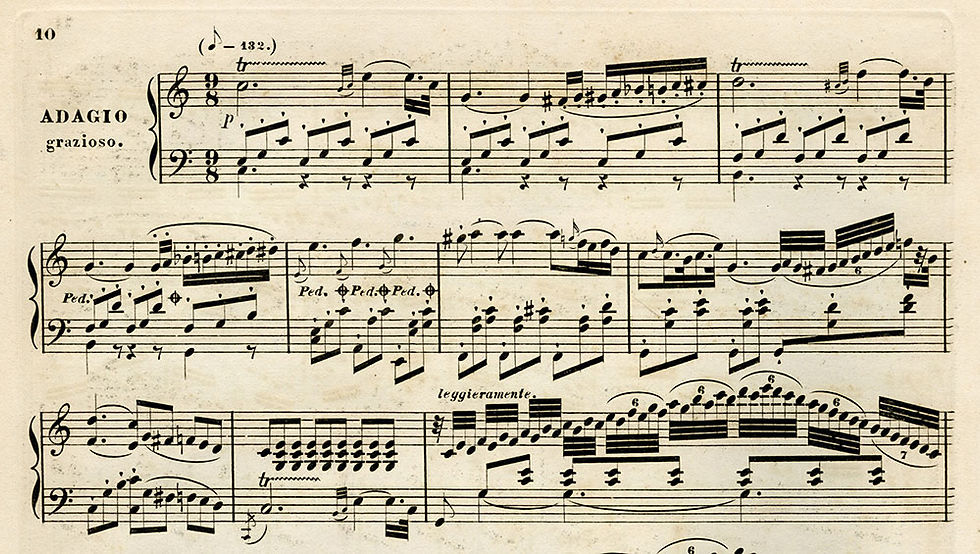
Both BGPS 15 (Cramer/Moscheles) and BGPS 18 (Spehr/Moscheles) lack pedaling and fingerings.
For the Hallberger edition (BGPS 51), Moscheles added fingerings, pedaling, and a few dynamic markings.

Pedaling, fingerings, metronome markings: Other Editions
Now let’s look at how some of the other later editions addressed these aspects.
BGPS 31 (Stern) was one of the earliest editions that added pedaling from the beginning of the movement, in addition to Beethoven's fingerings:

More precise application of the pedal was indicated in BGPS 42 (Holle), BGPS 45 (Weinholtz), BGPS 58 (Ashdown & Perry), BGPS 59 (Boosey/Dorrell), BGPS 69 (Rózsavölgyi), and many others. BGPS 172 (Tovey/Craxton) added some pedaling in 1958 but removed it in revised edition.
BGPS 221 (Sonoda) was one of several editors who applied special symbols to indicate release of pedal:

Although many editions adopted Moscheles’s tempo of ♪ = 132, others used the tempos established by Czerny ( ♪ = 116 or ♪ = 126). Bennett (BGPS 36) and Brissler (BGPS 61) were among the editors who preferred the slower tempo (♪ = 116).
Hallé (BGPS 50) chose the slightly faster tempo of ♪ = 126, as did Ernst Pauer (BGPS 75) and Moszkowski (BGPS 145 and BGPS 164) (Moszkowski). However, these editions differ in their approaches to fingering and pedaling.
Hallé’s edition adds English fingering (where the thumb is indicated with +) as shown in this example of m. 26, but lacks pedaling:

Pauer omits fingerings but Moszkowski adds fingerings and just a touch of pedaling:

Another popular tempo was ♪ = 112, which was adopted by Fumagalli (BGPS 77), Lebert (BGPS 84, BGPS 90, and BGPS 108), Germer (BGPS 107), Watson's revision of the Liszt edition (BGPS 139), Trneček (BGPS 159), Schnabel (BGPS 162, BGPS 185, BGPS 107, BGPS 224), and Macpherson (BGPS 133), among others. The examples shown below illustrate how these editors approached fingering, pedaling, phrasing, and other aspects of interpretation of the opening passage:


You’ll note that several of these editors suggested execution of the opening trill through fingerings and/or provided precise notation. The edition by Goldenweiser (BGPS 170) notates the trill above the staff and adds fingerings and numerous pedal markings, but lacks a metronome marking:

The editions by Corder (BGPS 154 and BGPS 165) received some negative press due to their overly intrusive approach to interpretation. In the case of op. 31/i, Corder not only replaced the original notation with the realized opening trill on the staff, he altered the key signature for middle section (mm. 42-65):


Returning to the metronome markings, a few notable editions suggest alternatives to those already discussed. BGPS 92 (Steingräber) uses ♪ = 120, a marking also adopted by Bussmeyer (BGPS 95) and Lamond (BGPS 161 and BGPS 223). Steingräber also includes fingerings, changes all strokes to dots, adds dynamic markings, and offers a few footnotes regarding the differences between editions, as shown in the example from mm. 26–35:

Lamond added a suggestion on execution of the cadenza-like passage at m. 26:

At ♪ = 108, BGPS 157 (Morgan) suggests one of the slowest tempos discovered among the collected editions. Morgan also includes plenty of fingerings but no pedaling:

At the other extreme, several editors suggest significantly faster tempos by emphasizing the dotted quarter note, not the eighth note, as the main pulse. For example, BGPS 120 (d’Albert) has ♩. = 46, while Winterberg (BGPS 130 and BGPS 149), and Friedberg (BGPS 152) all adjust that to an even faster tempo, with ♩. = 50. The d’Albert edition also changes the strokes to dots and adds fingerings, pedaling, dynamic markings, and other notes on execution:

The Winterberg edition likewise changes the strokes to dots, adds fingerings (including alternatives), and a few pedal markings:

Alternative fingerings are also a feature of the Friedberg edition, which lacks pedaling and editorial dynamic markings:

Regarding dynamic markings, BGPS 43 (Heugel/Marmontel) was an early example of editorial insertions of hairpin crescendos and decrescendos as well as fingerings:

A similar approach was taken by Kühner in his revision of the Liszt edition (BGPS 97):

BGPS 100 (Simrock/Riemann) contains many changes in dynamics and articulation, but no fingerings or pedal markings:

BGPS 209 (Taylor) adds many dynamics. To indicate his editorial additions, he inserts a vertical slash through the hairpins.

Although Taylor converted the strokes to dots, he added a footnote about playing them like string pizzicato. Many other editors simply made the change without comment. The Schenker editions (BGPS 180 and BGPS 200) were among the few published in the 20th century that retained the strokes:

Among the most recent editions, of special note is BGPS 225 (Gordon), which includes footnotes on different approaches to interpreting certain passages by other editors, including realization of the trills:

A few recent critical editions also reinstate the staccato strokes as well as provide fingerings.
BGPS 227 (Gertsch with fingerings by Perahia):

BGPS 235 (Hauschild/Reutter with fingerings by Günter Ludwig):

If you discover other variant readings of this movement that you would like to share in the blog, please send them to [add email address here].


Comments